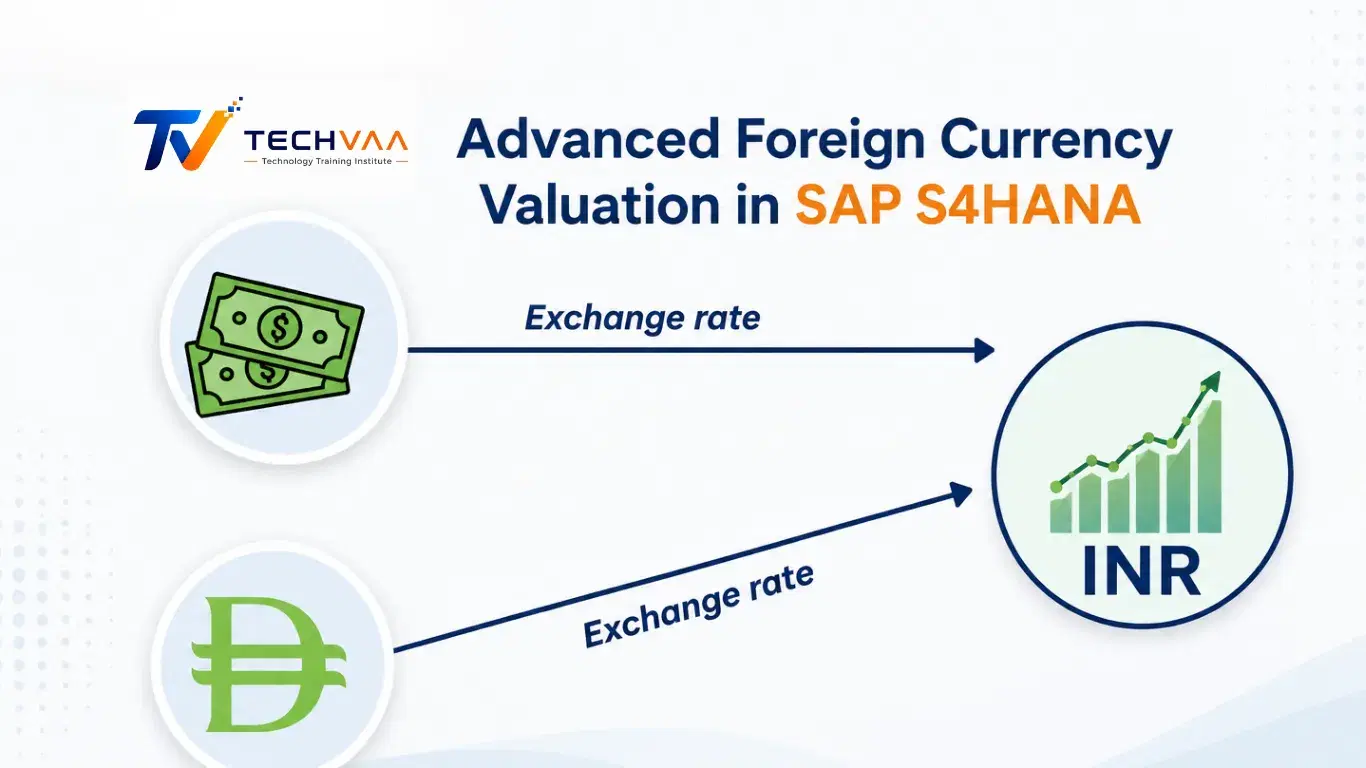
Introduction:
Advanced Foreign Currency Valuation in SAP S/4HANA is a period-end process used to revalue foreign currency transactions based on the latest exchange rates. It ensures accurate financial reporting by recognizing unrealized exchange gains and losses in accordance with accounting standards.
What's new in Advanced Foreign Currency Valuation in SAP S4HANA?
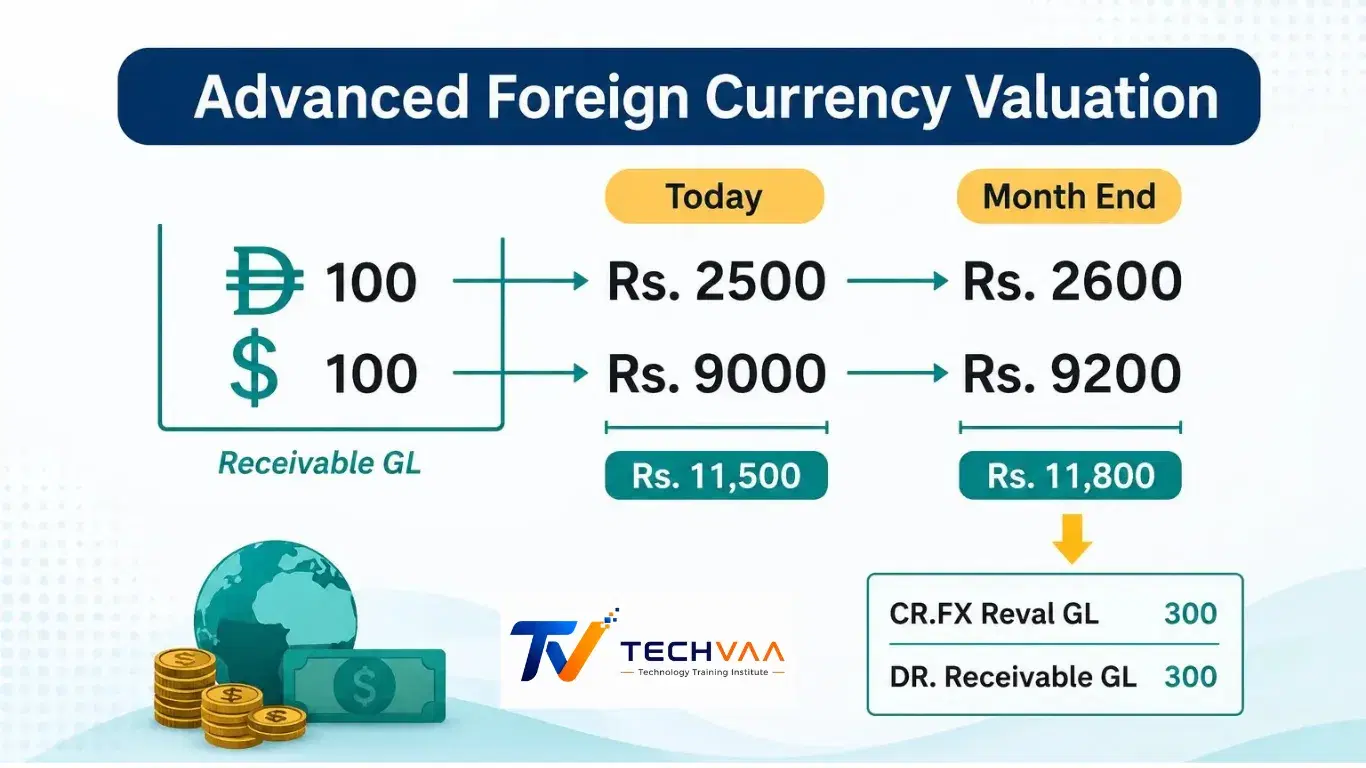
Foreign currency valuation means calculating your foreign currency amount into local currency amount. Any valuation gain or loss is unrealized.
Suppose you have money in three currencies, Rs. 500, $10 and 100 AED. Tell me how much total money you have in INR?
You will convert $ & AED amounts to INR using current exchange rate. Now after 5 days if I ask you again how much total money you have in INR, again you will convert $ & AED amounts to INR using that day exchange rate. Since exchange rate has changed hence you may have more or less amount in INR than earlier. This gain or loss is just notional and hence it is called unrealized gain or loss.
This gain or loss is occurring due to exchange rate changes in foreign currency hence it's referred as foreign currency valuation gain or loss.
Now let's understand from company's perspective. Why companies need to perform foreign currency valuation at month end?
Companies normally do business across country. Hence they have some transactions in foreign currency also. There may be accounts receivable from export customers in foreign currency, there may also be vendor invoice from foreign vendors in foreign currency.
At month end, company has to prepare balance sheet and profit & loss statement, these financial statements can not be in multiple currencies hence every balance needs to be reported in company code currency (local currency). Hence any foreign currency amount is converted to company code currency using current exchange rate.
When foreign currency transaction was posted, that time exchange rate may be different than exchange rate at month end. Hence at month end, we may have difference in company code currency amount. This difference is only notional, its called unrealized because we are only calculating impact of exchange rate changes. Actual payment from customer is not received, actual payment to vendor has not happen. We are only calculating company's net position at month end.
SAP FICO S4HANA interview question on foreign currency valuation
Explain changes in foreign currency valuation in SAP S4HANA
SAP S4HANA comes with 'Advanced foreign currency valuation'. In S4HANA, foreign currency revaluation can be executed for a specific ledger instead of whole company code. This means that you can post foreign currency valuation in local accounting law (non-leading ledger) without disturbing Group accounting principle (leading ledger).
Earlier in ECC, t code to execute foreign currency valuation was FAGL_FCV but in S4HANA Fiori app "Execute Foreign Currency Valuation" is used to perform foreign currency valuation.
In advanced foreign currency valuation only delta amount is posted, there is no need for reversal in next month. Earlier in foreign currency valuation, every month end valuation was posted and next month it was reversed. But in advanced foreign currency valuation, reversal is not done because only delta amount is posted at month end. Posting happens only if net position in company code currency is different from existing.
What accounting entry is posted as a result of foreign currency valuation?
Whatever gain or loss happens as a result of foreign currency valuation is posted to a P&L account (FX revaluation account) and offsetting line is posted to original GL which is being valuated.
Do we assign separate P&L account for gain and loss resulting from foreign currency revaluation?
No, separate P&L account is not needed. Normally companies use same P&L account for both gain or loss. When loss happens, foreign currency revaluation account is debited and when gain happens it is credited.
Foreign currency valuation is applicable to which accounts?
It's applicable to accounts which are posted in foreign currency and are open item managed like Customer account, vendor account or Open item balance sheet gl account.
What happens to unrealized gain when open item is cleared and exchange rate difference is realized?
When open item is cleared and exchange rate difference is realized then two things will happen. Realized exchange rate difference is posted and unrealized exchange rate difference is reversed.
CR. Realized exchange rate difference
DR. Original GL account
DR. Unrealized exchange rate difference
CR. Original GL account
It can be executed for a specific accounting principle / ledger.
Advanced foreign currency valuation works on delta logic.
Next month reversal is not needed because only difference between existing valuation amount and new valuation amount is posted.
When open item is cleared, existing unrealized difference is reversed and Realized difference is posted.
Offsetting line item is the original GL account which is being valuated.
Configuration works on semantic tags and valuation rules instead of valuation area in classical foreign currency valuation.
Conclusion
Foreign currency valuation is a period end activity. It shows company's balance sheet position at month end in local currency. With new functionality "Advanced Foreign Currency Valuation" it's possible to run foreign currency valuation for a specific accounting principle and ledger. This blog will definitely help you prepare for your sap fico s4hana interview.